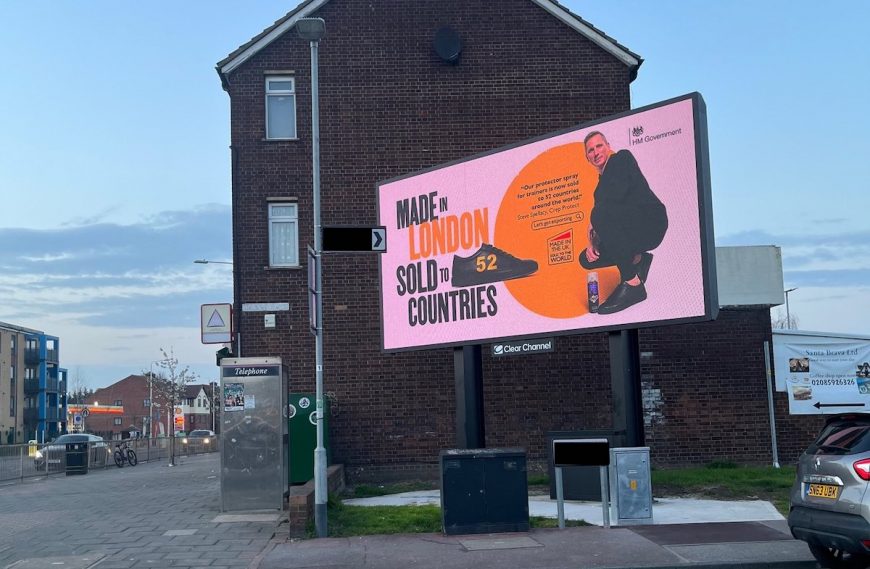
Thanks to Julia Williams for this guest blog telling her story of the sudden appearance of a large digital advertising screen immediately outside her flat in Barking & Dagenham in 2021.
It’s funny how people become mildly offended when you suggest they’re being influenced by advertising. “Advertising doesn’t affect me,” they’ll claim. Then later they’ll say “Every little helps” or “it does exactly what it says on the tin” without any sense of irony or self- awareness. Ask around and most people will tell you there isn’t much outdoor advertising where they live, and certainly no giant, flashing digital screens. But if you challenge them to have a proper look and report back the next day, their eyes tend to be opened quite quickly. Mine certainly were.
The moment everything changed
In August 2021, a huge digital advertising screen appeared directly opposite my flat. Right in the middle of the pandemic, a mature tree was removed, a deep trench of concrete was laid, and an 18 square metre screen went up in its place. All for my personal benefit, apparently.
BEFORE:

AFTER:

Sometimes in old American films, the unfortunate character ends up in a cheap motel with a flashing neon sign outside the window, filling the room with bright white light on and off every few seconds. That’s more or less my situation, except I don’t get to check out of the motel. I live here.
I suppose I should feel honoured. I’m one of the few people who get a full, uninterrupted view of it, along with a handful of equally unimpressed neighbours. So far, I’ve been offered Royal Ascot tickets, luxury holidays, hot tubs for a garden I don’t have in my one-bedroomed ex-council flat, and a steady stream of adverts for fairly unappealing junk food that I wouldn’t touch with a barge pole.
Learning the language of billboards
Since then, I’ve become unexpectedly familiar with the technical side of these things. For example, I now know that this type of screen can use a substantial amount of electricity, comparable to several households over the course of a year, and that it operates continuously as part of a wider advertising network.
I’ve also spent time looking into how these screens are regulated, and the way current planning laws, which predate widespread digital advertising, still treat them in much the same way as traditional paper billboards.
Much of this sits under legislation and regulations that were never designed with modern digital advertising in mind. What I didn’t expect was how difficult it would be to challenge.
Because once something like this is in place, the conversation quickly becomes less about what residents experience or whether the correct processes have been followed, because it becomes clear that outdated national legislation can often make it challenging for local decision-makers to refuse these applications.
What residents actually experience
From a resident’s point of view, the impact is very simple. It’s bright. It changes constantly. And it’s always there, seven days a week. From 6am onwards, it’s intrusive. At night, it’s something else entirely. People shouldn’t have to think about closing their curtains just to avoid a commercial screen shining into their homes. That’s not a minor inconvenience. It has a real impact on the local environment and how the area feels.


What was there before
The space the screen occupies used to be something quite different. Not spectacular. Just a small decorative green with a tree that had taken time to establish itself. Nothing special, but it mattered. It softened the street. It gave the area a sense of space. Now it’s gone, replaced by something too bold, that dominates everything around it.
Trying to understand how this happens
Like most people, my first instinct was simply to ask how something like this could appear in a residential area in the first place. What I’ve since come to understand since is that these decisions sit within a national planning framework that wasn’t designed for modern digital advertising. In many cases, applications must be treated as updates to existing paper billboard sites, even when the visual and environmental impact is significantly different.
That makes it difficult for planners, residents and councillors to challenge developments like this, even when they feel completely out of keeping with their surroundings. So the issue isn’t just about one screen. It’s about whether the current system is equipped to deal with what’s now being installed.
A wider question
In some cases, developments like this are linked to funding for local projects, things like planting trees or improving green spaces. Sometimes these huge multinational companies decide to offer support to local charities as part of a community engagement remit. On paper, that sounds like a positive outcome. And in many ways, it is.
But it also raises a more uncomfortable question. Is it enough for charities and community groups to look at what the money can be used for, or should they also think more deeply about where it comes from? That isn’t about rules. I think it’s also a wider question of judgment.
Why this matters beyond one street
This isn’t just about one screen outside one flat. It’s about the gradual spread of infrastructure that changes the look and feel of the places people live. It’s about how advertising increasingly becomes part of everyday life. Much of it promotes products that do not always align with healthier lifestyles and contributes to wider issues like litter and a negative environmental impact.

And it raises a broader question about whether the national planning system has kept pace with the reality of large-scale digital advertising. If these developments are becoming more common, then it’s reasonable to ask whether the rules governing them need to be updated. Because at the moment, once something like this is installed, it becomes part of everyday life for the people living next to it, and very difficult to remove.
Despite my best efforts the screen is still there. The tree isn’t. And the question of whether this is the right place for it hasn’t gone away.

Published by