
Unless you’ve been living under a rock for the last two weeks, you will almost certainly have seen ads from Amazon promoting Black Friday, that annual festival of consumerism. This is unsurprising: Amazon is the UK’s largest spender on advertising.
Looking at the majority of Amazon’s adverts, whether touting Black Friday or otherwise, what is striking is how not striking they are. In an “attention economy” where many adverts are getting bigger, bolder and ever-more intrusive, Amazon’s ads seem, by comparison, boring.
This perhaps serves as a clue to their true purpose, and the alarming truth about Amazon itself. Amazon’s ads aren’t there to convince you to shop with Amazon because they don’t need to convince you: you don’t have any choice. In fact, there’s a good chance you’re using an Amazon product to read this blog right now, just as I’m using an Amazon product to write it. Amazon Web Services is a cloud computing provider that underpins some 30% of the web today, that’s everything from Adfree Cities to government websites all running off Amazon’s infrastructure.
Amazon’s advertising is therefore not a promotion in any traditional sense, but instead acts as a reminder, a drumbeat directed at your subconscious mind reinforcing the omnipresence of Amazon in our lives. Amazon’s advertising is a tool of normalisation that shuts off what we think of as possible and narrows our imagination to only what is, and what is is Amazon.
The surround sound of advertising drowns out the background noise of Amazon infesting itself in the fabric of our lives, and the toil this takes on people and planet. Amazon is a parasite. Its astronomical profits are drawn from worker exploitation, tax dodging and planetary destruction.
The true cost
Amazon’s workers are amongst the most surveilled and monitored in the world, with every movement logged and even toilet breaks scrutinised. Such is the punishing nature of Amazon’s work regime that many workers report injuries like sprains, and other report having to work despite injury simply to keep up with quotas.
Read more in our article in The Ecologist Magazine
In November, a worker at an Amazon distribution centre in Erfurt-Stotternheim, Leipzig, Germany, died whilst on shift. Local union Ver.di alleges that Amazon ignored the employee’s previous efforts to report his sickness. Amazon denies any wrongdoing.
It has been estimated that as much as 80% of everything purchased on Black Friday ends up in landfill, resulting in 1.5 million tonnes of waste. E-waste from computers and other gadgets often ends up being exported to countries in the Global South, such as Nigeria and Ghana, where it piles up in toxic heaps poisoning land and water.
Amazon’s tax dodging amounted to upwards of £575 million in 2024. That’s money that could be funding essential services like the NHS or education, but is instead lining the pockets of shareholders and, of course, Jeff Bezos.
Amazon isn’t just siphoning profits. Thanks to investments in AI and data centres, Amazon is now a major user of water. Data centres, used to store and process the vast amounts of data needed to train and employ AI, rely on a continuous supply of water to cool the computers within. In parts of the US where data centres have been around for longer, the impacts of this are already clear from reduced water availability for those living nearby, to higher concentrations of toxic and cancerous agricultural pollutants. In the latter case – covered in great detail here – Amazon continued to enjoy healthy tax breaks from the local government in return for ‘supporting the local economy’.
ZAP Games 2025
To challenge the power of Amazon, and to break the spell of advertising over our lives, activists across the world have been taking part in the ZAP Games, two weeks of subvertising organised by the Subvertisers’ International.
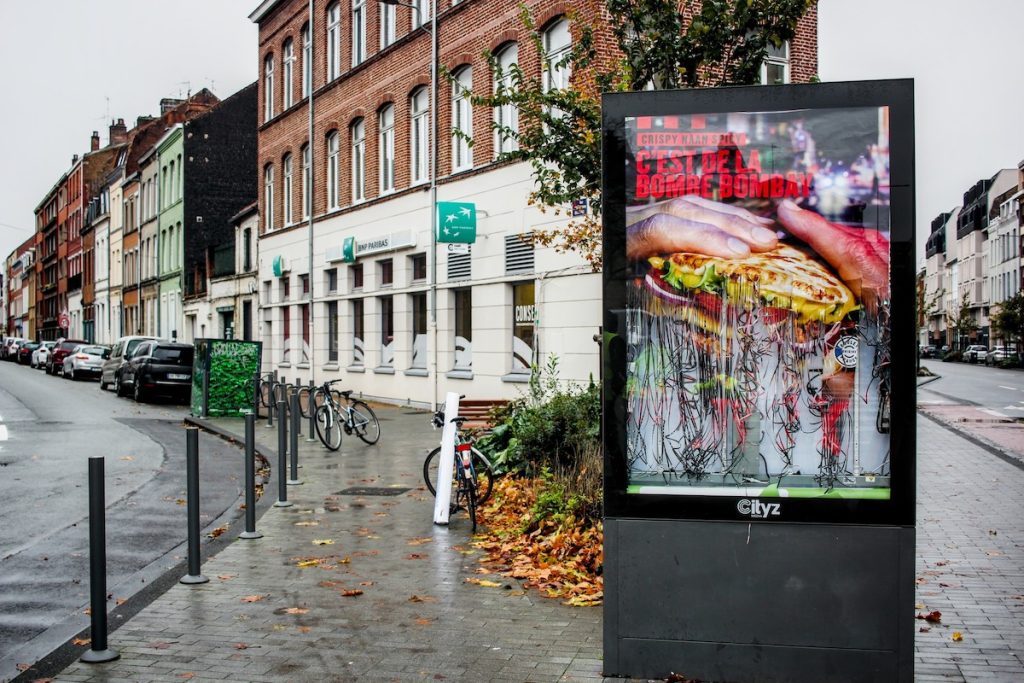
Activists in France shredded adverts, others covered them with alternative slogans; activists in Germany placed posters expressing solidarity with Amazon workers directly outside an Amazon fulfillment centre; in London, large billboards were hacked with posters critical of Amazon’s tax dodging and creeping surveillance; whilst in Bristol, activists transformed a humble bus stop ad screen into a time machine, encouraging passers-by to imagine post-consumerist futures.



What can we do?
We all seek out bargains when it comes to buying the things we need. However, we also need to be aware of what’s happening behind the scenes to keep the prices down. Glimmers of hope exist for resistance to Amazon’s spread.
- For one, it seems the public are wising up to the fact that many Black Friday deals are anything but, and in many cases products advertised around this time are more expensive than at other times of the year.
- This year, as in previous years, there have been strikes, walkouts and protests at Amazon sites in at least 30 countries. The ZAP Games offers a creative response and alternative use for public spaces beyond commercial messaging.
- Adfree Cities is a member of the Make Amazon Pay coalition of workers, activists and citizens from across the globe united in the effort to stop Amazon remaking the global economy in its own image.
Finally, we can also reduce our exposure to Amazon ads, Black Friday ads and all other ads by restricting the expansion of advertising into our public spaces. We work with local people to object to new proposals for billboards and ad screens in towns and cities. We’re also campaigning to change planning rules so that councils have greater powers to say no to new ads.
Feature image: Michelle Tycliki (@Shelkadelic) for Brandalism.

Published by