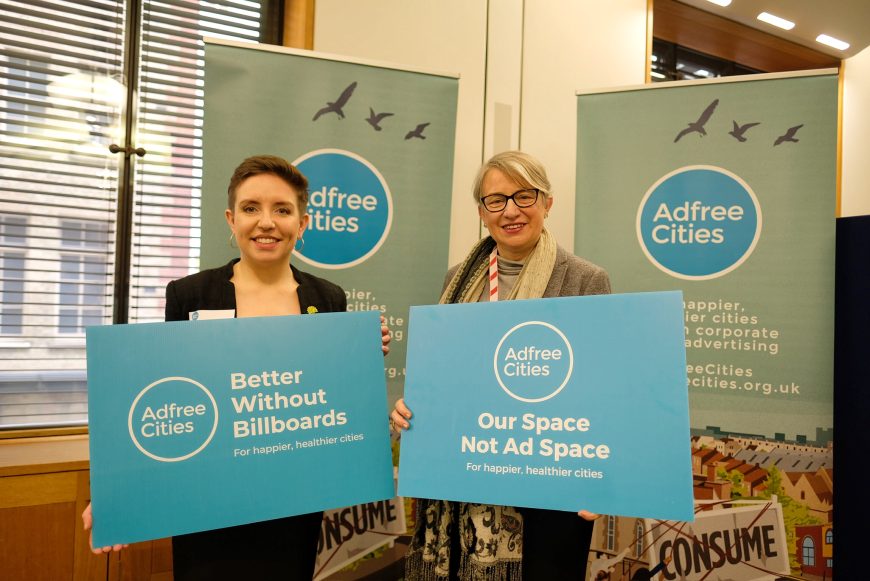
During a House of Lords committee meeting on 9 September 2025, Green peer Natalie Bennett made comments defending amendments to the Planning and Infrastructure Bill first proposed by Carla Denyer with the support of Adfree Cities.
Speaking for the amendment (which you can watch on Instagram here), Bennett said:
“Noble Lords should think about how, when they were coming into the House today or when they are going home tonight, they are bombarded with advertisements for gambling companies, junk food and polluting substances. The odds are that there are a lot of them, and this is having a negative impact on public health…
What if, in those spaces, we had community arts… or indeed, let us have some more trees. Would not that be nice?
“I pay tribute to the campaign group Adfree Cities, the inspiration for the amendment, which wants a complete ban on all outdoor corporate advertising. As one of its campaigners said, these ads are in a public space without any consultation about what is being shown on them. They cause light pollution—often these days they are digital—and they are for things that people cannot afford or do not need. The fact is that advertising is designed to make you miserable and suggests that you should spend some money to fix that misery…
“In thinking about the public health impacts of this, Dr Nathan Critchlow from the Institute for Social Marketing and Health at the University of Stirling said: ‘There is consistent evidence that exposure to marketing for unhealthy commodities—for example advertising for alcohol or food and drinks high in fat, salt, or sugar—is associated with consumption, including among … young people’.
“This is being pushed to people and their health is suffering as a result. Many people will be familiar with the ban from Transport for London on unhealthy food advertising, which a study found prevented almost 100,000 obesity cases.
“We can think of the positives instead of just the negatives. What if, in those spaces, we had community arts. One thing that our cities, towns and villages lack is more community arts, such as murals and local projects —or indeed, let us have some more trees. Would not that be nice?
“It is worth saying that this is very much a public health issue. Adfree Cities found that four in five outdoor billboard advertisements are in the poorest half of England and Wales. They are actually increasing inequality, so we need something different there.”
Lord Jamieson, a Conservative peer, supported Bennett, calling the amendment “thoughtful”.
How did the government respond?
Responding for the government, Baroness Taylor of Stevenage said that planning system for outdoor advertising:
“……is designed to ensure that outdoor advertisements are in the right locations. It is a light-touch system concerned with only two issues: the impact of the advertisement on amenity and public safety. Amenity includes oral and visual amenity and relevant factors such as the general characteristics of the locality. Public safety is largely concerned with the transport network: for example, distractions to road users or safety on railway lines.
The content of advertisements is subject to a separate regulatory system—I know the noble Baroness is aware of this—which is overseen by the Advertising Standards Authority. To widen the scope of matters which can be considered through the advertisement consent regime, particularly in relation to public health, is likely to bring the focus more on to the content of the advertisement. If that were the case it would create an overlap between the two regulatory regimes where at present there is a clear distinction, which would risk causing uncertainty and confusion.
Therefore, while I understand what the noble Baroness is trying to achieve, we think the current scope of the advertisement consent regime remains appropriate.”
The full debate can be read in Hansard.

Published by