
Our food system is broken and dishonest. A number of excellent reports and campaigns have recently been launched which show that, in multiple ways, we are badly misinformed about where our food comes from, and that the food system and its dominant messages continue to drive consumption of unhealthy and unsustainable food.
The health of citizens, animals, nature and the climate suffer as a result. But as well as warning us about these impacts, these reports and campaigns are showing a way forward – through holding companies to account for misinformation and harm, ensuring citizens are given the real story about their food, and calling for bold policies to transform our food system and ensure that everyone has access to healthy food.
Here we take a look at some of these latest initiatives and what they show us about an alternative, kinder, path ahead.
Unhappy eggs
Let’s start with the Animal Law Foundation (ALF)’s excellent report on Food Chain Misinformation. They found that despite 85% of farmed animals in the UK being confined in intensive conditions where cruel practices are standard, advertising from retailers overwhelmingly shows healthy animals in outdoor settings, often depicting small farms, and misleadingly showing animals alongside their offspring.
The ALF report also explores how fake farm names are used by supermarkets to falsely suggest these products come from small scale British farms. Tesco’s ‘Willow Farm’ brand chickens likely come from Avara foods, a huge supplier of chickens whose operations in the Wye Valley are polluting the river and damaging the land.
The ALF team last week unveiled a billboard ad in London which showed the reality for factory farmed chickens compared to a typical scene from an egg advert, to expose the misinformation which typifies such adverts.
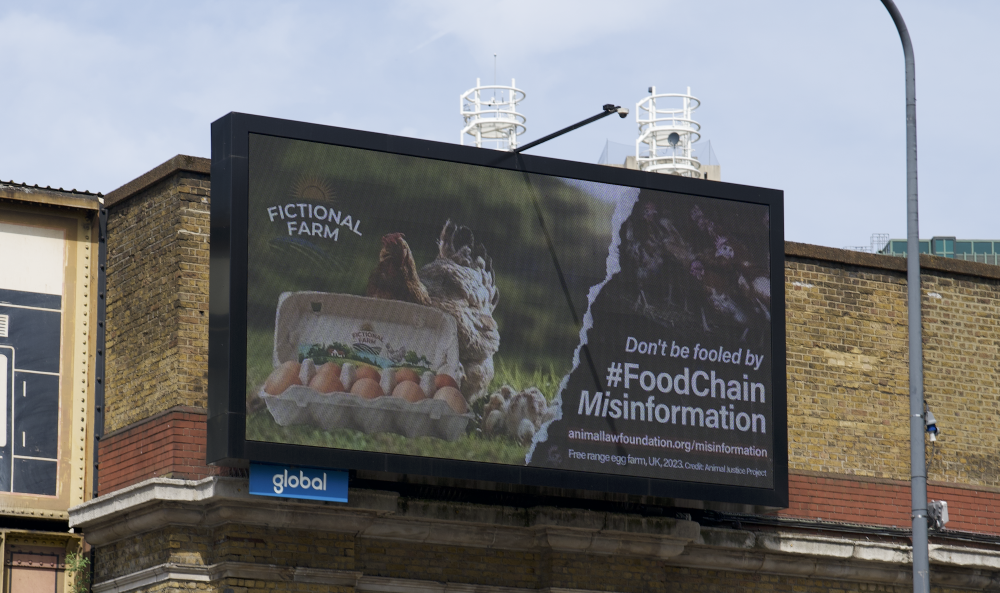
What can be done? The ALF recommends greater transparency and information:
“We have seen how more information drives different decision making, for example, in the UK, the sale of higher-welfare, cage-free eggs increased by 43% when mandatory labelling was introduced. The food market is being distorted through a lack of transparency. More ethical food production is not getting the advantage it most likely would if the less ethical production was being marketed honestly, or at the very least not deceptively. The hope is that this changes, that the public is given the information it is entitled to under the law as consumers of products and information.”
This message is echoed by Food Facts, whose mission is to analyse claims about food and sort the fact from the fiction. They take a look at the misleading term “Grass-Fed Beef” – which may, surprisingly, mean a cow has spent much of their life indoors. They recommend that we all call for greater transparency and regulation of misinformation from the food industry.
The hidden impacts of industrial fishing
Elsewhere, also on the problems with misleading labelling, an investigation by DeSmog found that seabass sold as ‘responsibly-sourced’ in UK supermarkets is driving “ecological colonialism” in West Africa. The fishes, farmed in Turkey, are fed by fishmeal caught in Senegal by an industry which is pricing women fish traders out of the market. Most people in Senegal are unable to afford a healthy diet, the fish populations they have depended on are in danger of collapse, and the fishmeal factories are causing pollution and health problems.
We don’t often think about fishes, and the impacts of overfishing are even more hidden that those of factory farming on land. As the recent Ocean documentary with David Attenborough explored, the devastating impacts of industrial-scale fishing are “out of sight, out of mind” – but the film offers a glimmer of hope in that life in the oceans can recover and thrive, if given the chance. It is promising that the UK government has since announced proposals to ban bottom trawling in over 40 Marine Protected Areas.
A takedown of unhealthy ads
Advertising is undermining our health, and our ability to choose healthier, more sustainable diets. A shift from meat-heavy to plant-rich diets won’t happen without action from government to encourage and incentivise it. That’s the basis of The Food Foundation’s latest briefing, Low hanging fruit, which sets out a policy pathway for boosting uptake of plant-rich diets. Their recommendations include reforming advertising, ensuring that advertising for unhealthy food is ended across all platforms including outdoor advertising.
This is crucial. As research on junk food ads outdoors from the youth-led BiteBack campaign shows, unhealthy food advertising outdoors is inescapable. Junk food giant McDonald’s dominates outdoor advertising space, representing 31% of the food and drink adverts surveyed in the study. What’s more, McDonald’s adverts were nine times more likely to be found in the most deprived areas. In a guest blog for Adfree Cities, BiteBack activist Prusha discusses the findings, and explains how Big Food seems to follow us everywhere on our streets, pushing us to make unhealthy choices. We need national government action – and BiteBack, like the Food Foundation, is calling for unhealthy food advertising to be restricted across outdoor advertising.
We deserve a world where health isn’t a luxury and junk food ads aren’t the wallpaper of our lives. – Prusha, BiteBack youth activist
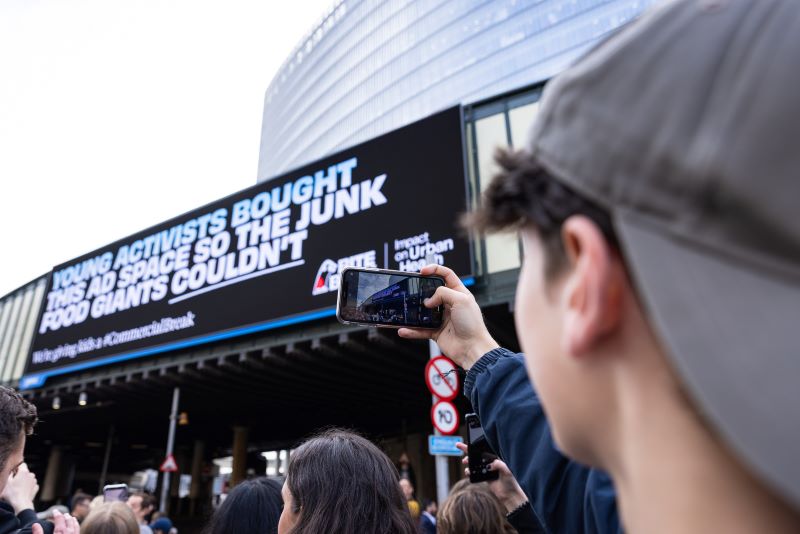
You’d be forgiven for thinking that such restrictions are on the cards, given the government declaration of a “prevention revolution” last September, announcing restrictions on unhealthy food advertising to protect children’s health, which were due to come into force this October. However, these restrictions do not include outdoor advertising – which as we stated at the time was a huge missed opportunity. What’s more, last month the government bowed to industry pressure and delayed the new legislation (which would restrict unhealthy food ads before 9pm on TV, and at all times online). Listen to Sustain’s Fran Bernhardt explain the catalogue of delays and dilution that has beset this legislation since it was first announced in 2020, in a short podcast from The Food Foundation.
Defining industrial farming
We need to start looking at restricting industrially-farmed meat and dairy advertising too, to address demand for those foods which are driving climate breakdown, nature depletion and animal suffering, not only poor health. One barrier to this has been the problem of identifying what we mean by industrial animal farming – which would help in designing policies and approaches which support more sustainable, kinder methods and which phase out more harmful ones. However, a recent report from Eating Better has shown that this is possible.
Eating Better have launched a comprehensive definition in their report “We need to talk about industrial livestock production”, which looks at a broad range of characteristics and their impacts on animal suffering, pollution, health, climate, nature and economic risks, to offer a definition of industrial animal farming. This exciting report is the first step in a long term plan to engage policymakers and business on transforming the food system, with a solid basis for defining what kind of farming we want to support, and what we need to phase out. We’d love to see this develop into restrictions on advertising for the products of industrial animal farming too.
Championing veg: who’s responsible?
Supermarkets clearly have a major role to play in the shift from meat-heavy to plant-rich diets, as they account for 95% of UK retail food sales, but despite public promises from retailers, they seem to be all talk and little action.
As The Food Foundation’s Broken Plate 2025 report earlier this year highlighted, over a third of food and soft drink advertising spend is on confectionary, snacks, desserts and soft drink, compared to just 2% on fruit and veg. Their 2024 report found that supermarket in-store promotions on meat were much more common than on fruit and vegetables. Switching this around would provide significant – and relatively easy – wins for our health, climate and for farmed animals.
The government’s upcoming food strategy is an opportunity to kickstart real transformation in the food system. Last month, a new policy briefing from Foodrise (formerly Feedback) and The Food Foundation found that most retailers are failing to deliver on their climate commitments, largely because to date these commitments have been voluntary. This is important because agriculture is set to become the highest emitting sector by 2050, and, as this article from Wicked Leeks says, meat and dairy are a major source of retailers’ Scope 3 emissions (these are emissions arising from retailers’ supply chains).
“Despite evidence that around half of supermarkets’ overall emissions are linked to meat and dairy sales, retailers have not demonstrated how they plan to address this challenge” – Commitment Issues report, May 2025
Recent reports from Changing Markets Foundation also explore failures of retailers and dairy companies to address their colossal contribution to methane emissions. A recent report zeroed in on dairy giant Arla. The “Dairytales” report finds that while the company celebrates their own sustainability efforts, they put a lot more effort into greenwashing, creatively calculating their emissions and lobbying politicians to prevent actual progress.
As Foodrise and Feedback conclude, mandatory reporting for all large food businesses is needed to ensure companies can no longer hide behind greenwash and empty promises, and to make real progress towards a more sustainable, heathier food system.
Government seems reluctant to mandate retailers to reduce sales of meat and dairy. But short of this, taking steps to shift demand from meat-heavy to plant-rich diets could have a huge impact too. Imagine if all the promotions and adverts encouraging us to buy burgers, fried chicken and unhealthy food were for apples, broccoli and lentils instead? A petition from campaigner Dale Vince is calling on the government to promote plant-based foods over meat and dairy.
All of these exciting reports and initiatives show that while we have huge changes to make, there is a clear path to do so, and a very possible future where a fundamental shift to a kinder, more sustainable food system is realised. There are inspiring examples from Europe we can draw from – such as exciting news from Switzerland that from July, food products of animal origin must show whether animals suffered painful practices in their production. This is an amazing step forwards in giving people information which Big Meat and Dairy try so hard to keep hidden.
As campaigner Dolly van Tulleken points out, there is a huge opportunity in the UK for the government to make food a political priority, as it is in other European countries. This means taking bold action in the face of lobbying by the food and advertising industries, stepping in to fix our long-neglected, broken food system and delivering what we all need: a healthier, kinder food system for all.
Main image: mural by Louis Michel; photo by @streetartatlas
Find out more about our work on meat and dairy advertising here.

Published by